Bessent defends U.S. dollar swap lines as Iran war harms global finances
Secretary of Treasury Scott Bessent testifies during a during a Senate Appropriations Subcommittee on Financial Services and General Government hearing on the Treasury Department’s 2027 budget request in Washington, DC on April 22, 2026.
Nathan Posner | Anadolu | Getty Images
Treasury Secretary Scott Bessent on Friday defended the possibility of the U.S. participating in currency swaps with allies in the Persian Gulf and Asia who are seeking financial backstops due to the Iran war.
Discussions with those countries about U.S. dollar swap lines “are part of ongoing, routine conversations that @USTreasury has been having with our partners over a number of years,” Bessent said in an X post.
“They are a testament to the U.S. dollar’s primacy and the strength of America’s economic shield,” he said of the potential swaps.
The assertion of swap lines’ benefits and commonness comes as the Trump administration considers offering the financial lifeline to the United Arab Emirates, CNBC reported Tuesday.
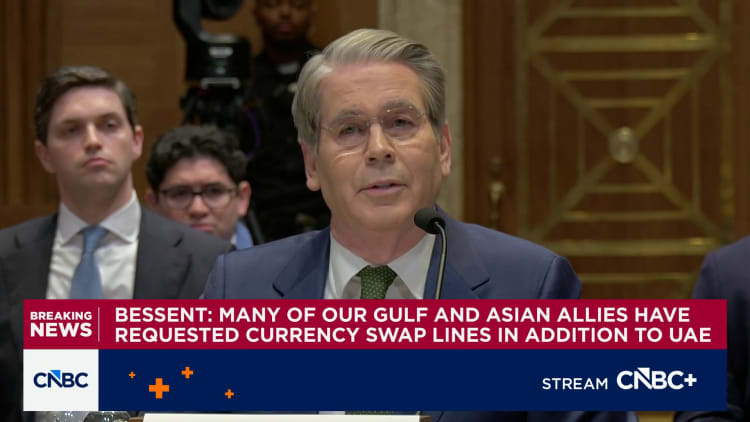
It also comes two days after Bessent said that “many” allies in the Persian Gulf are seeking the same backstop as the ongoing war wreaks havoc on the oil-rich nations’ economies.
Swap lines involve two countries’ central banks agreeing to exchange equivalent amounts of each other’s currency, while agreeing to swap back those quantities at a specified future date. The U.S. maintains “standing U.S. dollar liquidity swap line arrangements” with the central banks of Canada, England, Japan and Switzerland, as well as the European Central Bank, to “enhance the provision of U.S. dollar liquidity,” according to the Federal Reserve.
The tool dates back to the 1960s and has been used to stabilize the Mexican economy in the 1980s, following the Sept. 11 terrorist attacks, during the 2008 financial crisis and at the beginning of the Covid-19 pandemic, according to a report by the Yale School of Management.
The maneuver is aimed at easing strains on global funding markets, giving breathing room to households and businesses of both participating countries.
Treasury can provide its own version of swaps using its Exchange Stabilization Fund, though traditional swaps are most often offered by the Federal Reserve.
The arrangements can pose political risks for President Donald Trump, whose approval ratings on the economy have sunk as war-induced supply shocks rapidly raise prices for gasoline and other products, exacerbating Americans’ existing inflation woes. The CNBC All-America Survey released Thursday found that 60% of respondents disapprove of how Trump is handling the economy.
A potential swap line runs the risk of being seen as an unnecessary bailout of a foreign country â especially if it’s a rich one like the UAE, which has one of the world’s highest per capita incomes.

Trump, asked on CNBC’s “Squawk Box” Tuesday about a possible UAE swap line, appeared to say he is in favor of it.
“If they had a problem … I would be there for them,” Trump said.
Bessent in Friday’s X post gave a full-throated defense of additional swap lines.
They “can benefit our nation by reinforcing dollar usage and liquidity internationally, maintaining smooth functioning in dollar funding markets, promoting trade and investment with the United States, and, in hypothetical stress scenarios, preventing disorderly sales of the U.S. assets as well as disruptions to U.S. markets, businesses, and households,” he argued.
“Many of these countries have pristine sovereign balance sheets and large dollar holdings â larger than many major economies with whom we maintain permanent swap facilities,” he wrote. Bessent didn’t name any countries in the post and he and Trump earlier this week only specified the UAE.
“I applaud our allies’ foresight and watchful risk management by exploring additional financial buffers during periods of market quiescence. Extending permanent swap lines can be a major first step in creating new U.S. dollar funding centers in the Gulf and Asia.”
Dollar dominance and reserve currency status are strengthened by constant long-term initiatives, including countering the growth of problematic, alternative payment systems,” he added. “Under @POTUS, this is American Economic Leadership at work.”
â CNBC’s Eamon Javers contributed to this report.